AFT Calculator

AFT Calculator

Calculate your Army Fitness Test score across all five events and instantly see your point total and pass/fail result.

Your Details

lb
reps
m:ss
m:ss
m:ss
Official Army scales Effective 1 Jun 2025 Nothing stored
Data source
Official Army AFT scoring scales
Table version
Approved 15 May 2025
In effect since
1 June 2025
Your data
Never leaves your browser

AFT Calculator Inputs and Validation

AFT calculator inputs consist of three selector fields and five raw performance entries, and the calculator validates each value before it produces a score. The selector fields decide which scoring table applies, so the reader completes them before entering any event result. The AFT calculator selector fields are listed below:

  1. Age Group: the age band fixed by the Soldier's age on the test date.

  2. Sex: the sex category that selects the General table, with no effect once the Combat standard is chosen.

  3. Scoring Standard: the Combat or General standard set by the Soldier's MOS.

The AFT calculator event entries follow the selector fields and are listed below:

  • Deadlift Weight: pounds, entered as a whole number.

  • Push-Up Repetitions: a whole-number count.

  • Sprint-Drag-Carry Time: minutes:seconds.

  • Plank Duration: minutes:seconds.

  • Two-Mile Run Time: minutes:seconds.

Validation checks every field for a numeric value inside the accepted range, rejects non-numeric entries, and asks for corrections before the calculation runs. The input sequence opens with the age group, the selector that fixes the age band for every event score that follows.

AFT Age Group on Test Date

The AFT age group is the age band that matches the Soldier's age on the test date, not the age on any earlier training date. AFT scoring tables use ten age bands: 17-21, 22-26, 27-31, 32-36, 37-41, 42-46, 47-51, 52-56, 57-61, and Over 62. The age band selects the column of the scoring table that converts each raw performance into points.

A Soldier who turns 27 before test day is scored in the 27-31 band, and the move into a new band changes the raw performance required for the same points while the 0 to 100 point scale stays the same. The age-band structure reflects the change in physical capacity across a career, so AFT scoring stays comparable between younger and older Soldiers.

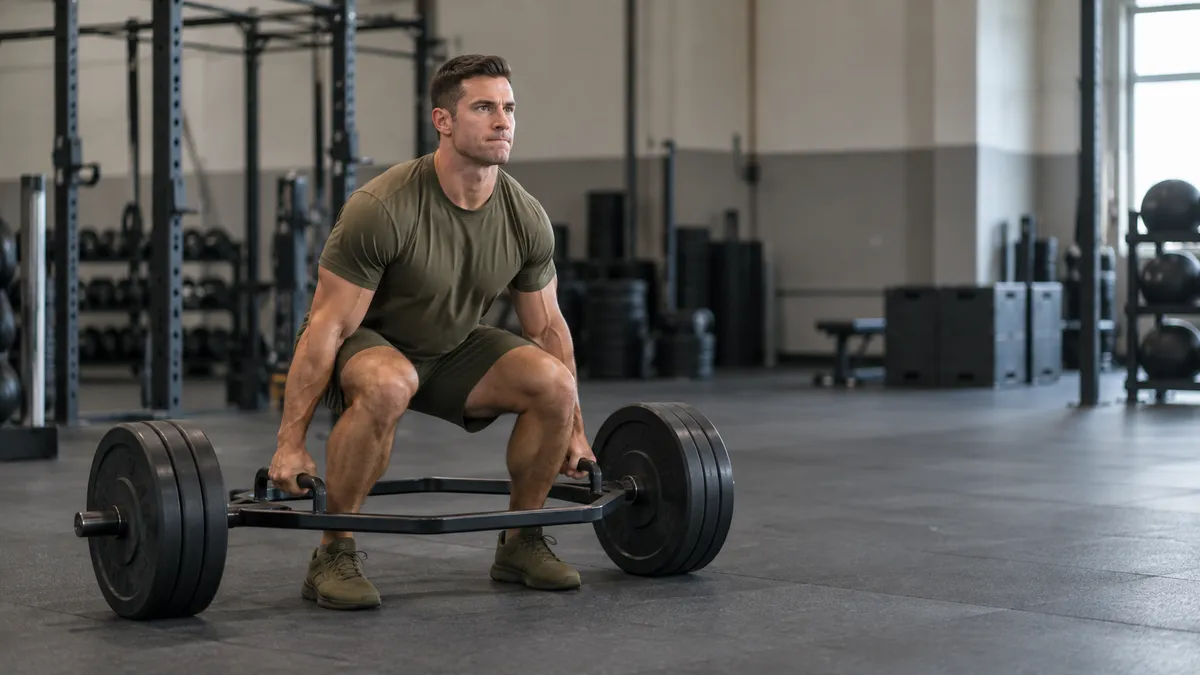
Soldier in the set position of a hex-bar deadlift in a gym, hands on the handles and back flat, about to pull.

Three-Repetition Maximum Deadlift Weight

The three-repetition maximum deadlift weight is the heaviest load a Soldier lifts for three continuous repetitions on a hex bar (trap bar). The AFT calculator takes the deadlift weight in pounds as a whole number. The Army deadlift chart lists weights in 10-pound steps, so the calculator scores a lift against the heaviest listed weight the Soldier reached. On the Male and Combat chart, 80 pounds scores 0 points and 90 pounds earns the first 10 points, while on the Female chart, 60 pounds scores 0 points and 70 pounds earns 10.

Deadlift points run from 0 to 100 through an age- and sex-normed table. Deadlift scoring is stepwise rather than linear, so a heavier lift raises the score only when the weight crosses into the next listed band. Knowing those band thresholds lets a Soldier plan strength progression in the steps the chart rewards.

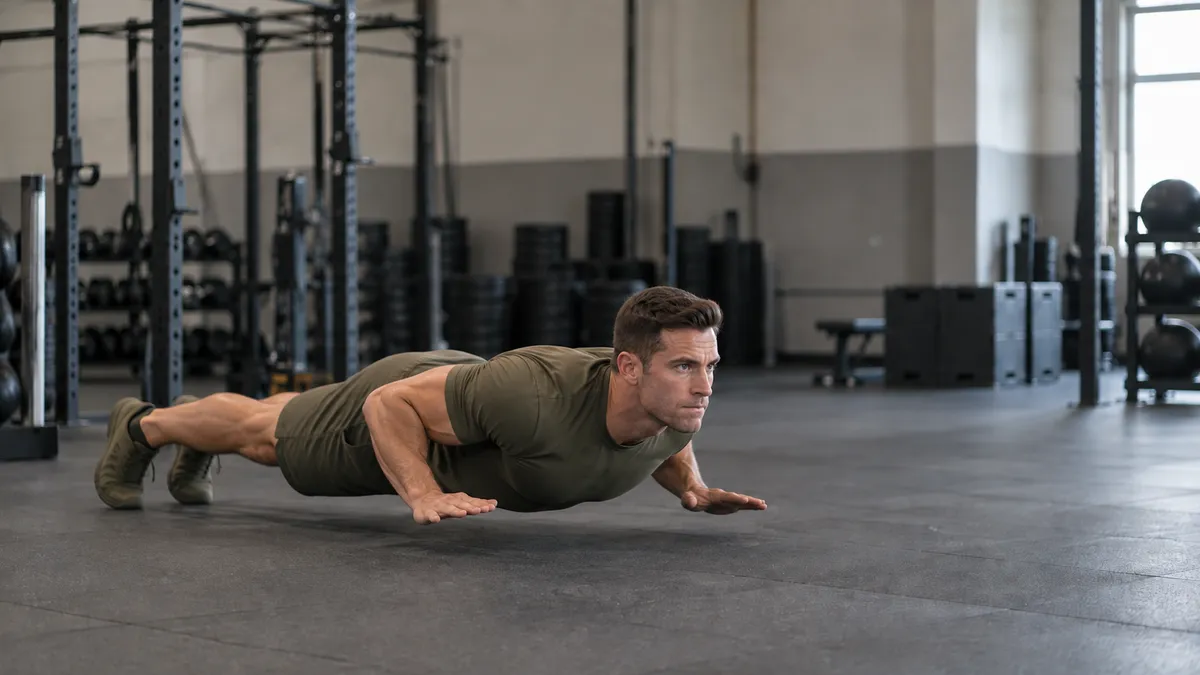
Soldier at the bottom of a hand-release push-up, chest on the gym floor with both arms extended out to the sides.

Hand-Release Push-Up Repetitions

Hand-release push-up repetitions are the number of correct repetitions a Soldier completes in two minutes. Each repetition requires the Soldier to lower the chest, hips, and thighs to the ground, extend both arms straight out to the side in a T position, return the hands to the starting position, and push back up to full elbow extension. Graders count only the repetitions that meet those form standards.

The AFT calculator takes the hand-release push-up count as a whole number and converts it to 0 to 100 points on the age- and sex-normed table. A push-up score below 60 points is an event failure, and one failed event fails the whole test regardless of performance in the other four events.

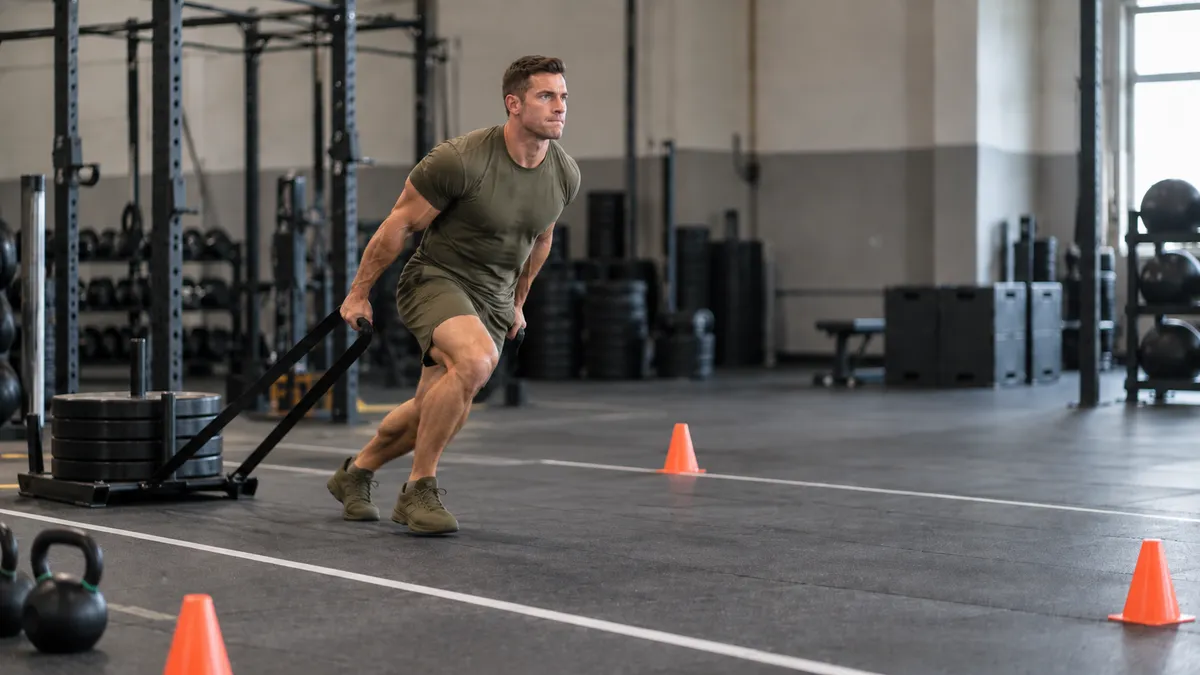
Soldier dragging a weighted sled backward by its strap along a cone-marked lane on a gym floor.

Sprint-Drag-Carry Time

The Sprint-Drag-Carry time is the total time for a 250-meter event made up of five 50-meter shuttles performed without rest. The shuttles run in a fixed order: a sprint, a drag of a 90-pound sled, a lateral shuffle, a carry of two 40-pound kettlebells, and a final sprint, testing speed, strength, and agility in one continuous effort. The AFT calculator takes the Sprint-Drag-Carry time in minutes:seconds. Sprint-Drag-Carry scoring is inverse: a lower time earns a higher score, so speed through all five shuttles drives the points.

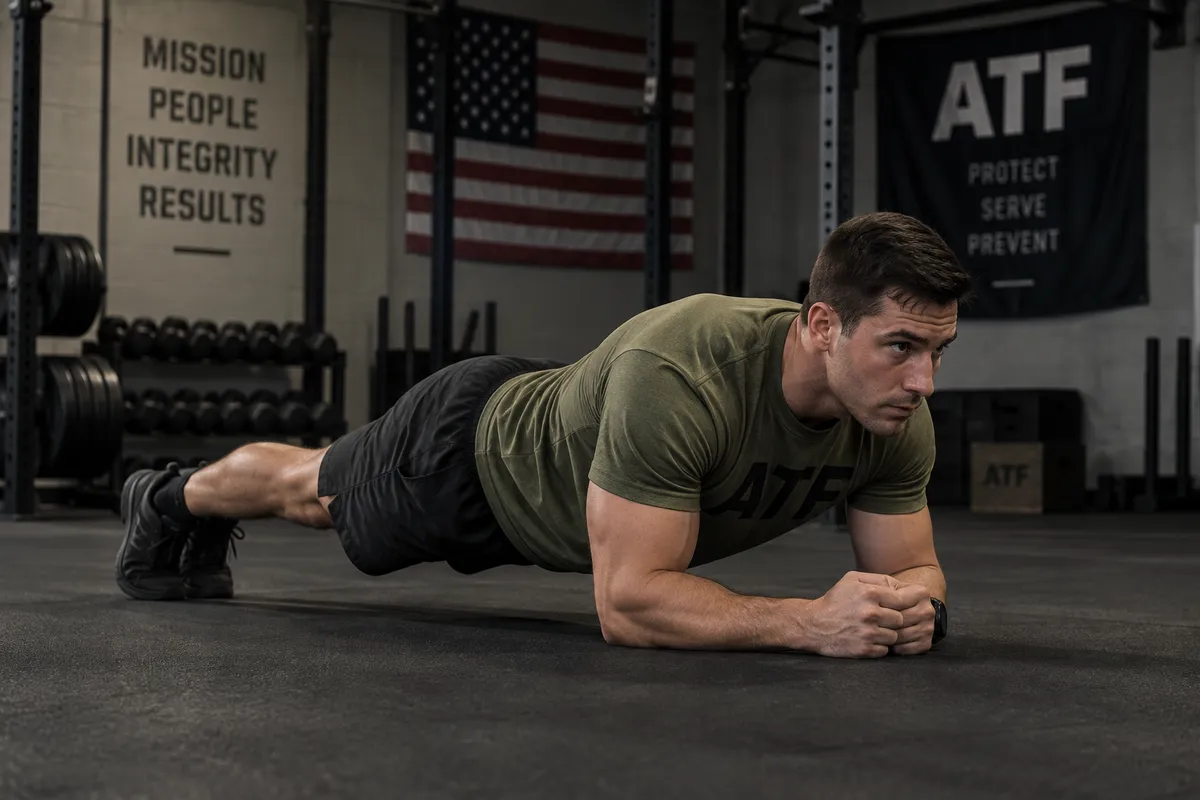
Soldier holding a forearm plank in a straight line from head to heels on a gym floor.

Plank Duration

Plank duration is the time a Soldier holds the forearm plank in a straight line from head to heels, entered into the AFT calculator in minutes:seconds, such as 2:45 for two minutes and forty-five seconds. Plank scoring is direct: a longer hold earns a higher score. The grader ends the event when the Soldier touches the ground with any body part other than the feet, forearms, and fists or palms, lifts a foot or hand, or fails to hold the straight-line position after one verbal warning.

The time at termination becomes the raw plank entry, which the calculator scores on the age-banded table, and the Army tables list the same plank times for male and female Soldiers. A small form lapse can end the hold, so plank points depend on form as much as on endurance.

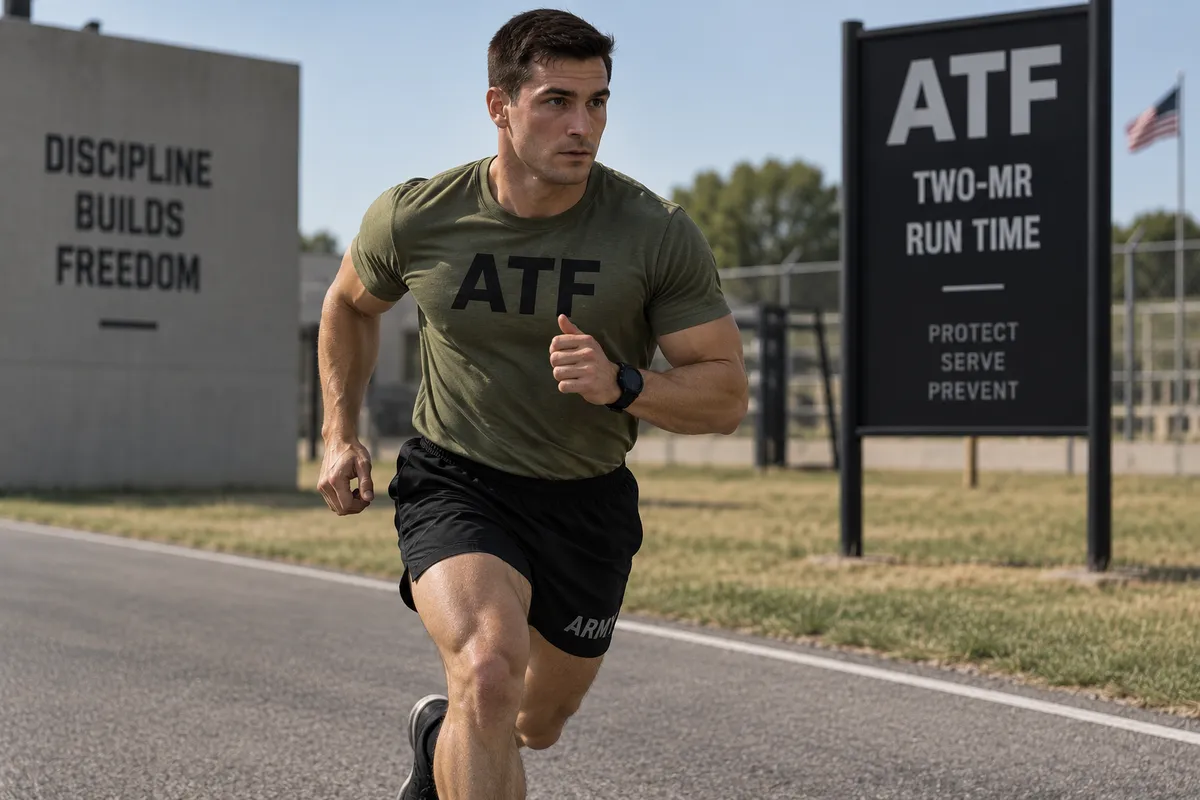
Soldier running on a paved outdoor course past a two-mile run sign.

Two-MR Run Time

Two-mile run (2MR) time is the total time to complete a measured two-mile course, and the event tests aerobic endurance. The AFT calculator takes the run time in minutes:seconds, such as 14:30. Run scoring is inverse, so a faster time earns more points, and each time maps to a point value on the age- and sex-normed table. The run time entry follows the same minutes:seconds format that every timed AFT event accepts.

Timed Event Formats and Rounding Rules

Timed event formats in the AFT calculator accept the Sprint-Drag-Carry, Plank, and Two-Mile Run in minutes:seconds, and the calculator treats each time as its equivalent in total seconds. The AFT timed-event format rules are listed below:

  • Minutes:Seconds and Total Seconds:

    an entry of 2:28 equals 148 seconds, and both forms score the same.

  • Whole-Second Granularity:

    the published tables list times in whole seconds, so the calculator accepts whole seconds only.

  • Partial Seconds and Table Rows:

    a time that falls between two listed rows earns the points of the lower-scoring row, because each row awards its points only to performances that meet or beat the listed time.

  • Integer-Only Entries:

    deadlift pounds and push-up repetitions take whole numbers without decimals, matching the stepwise point bands of the Army tables.

Standardized entry formats keep every AFT calculator estimate aligned with the Army scoring criteria.

AFT Score Calculation Method

The AFT score calculation method runs in four steps: raw entry, table lookup, event points, and total. The calculator matches each raw performance to the scoring table for the Soldier's age group, sex, and standard, and each lookup returns 0 to 100 points for that event.

Raw Performance to Event Points

Raw performance converts to event points through a lookup in the table that matches the Soldier's age band, sex, and standard. The AFT tables use stepwise point bands rather than a linear scale, so points rise in discrete steps as performance improves, and below 60 points the deadlift and push-up charts drop in 10-point steps, according to the "Army Fitness Test Score Tables" published by the U.S. Army, effective June 2025. Each event scores from 0 to 100 points, and 60 points is the minimum to pass an event. The 60-point floor means no event passes without reaching the table's minimum passing row, which keeps physical capability balanced across all five events.

AFT Score Results

AFT score results show each event's points, the total score, and a pass/fail determination. The five events (3-Repetition Maximum Deadlift, Hand-Release Push-Up, Sprint-Drag-Carry, Plank, and Two-Mile Run) each contribute to the total, and the pass/fail flag shows whether the total threshold and the 60-point minimum per event were both met.

AFT Event Scores and Minimum Requirements

  • AFT event scores appear in the results with each event's point value beside its pass/fail flag, showing whether the event met the 60-point minimum.
  • An event below 60 points is marked as a failure, which points to the area that needs work before a record test.
  • The event results include the distance to the next scoring band, such as the extra deadlift weight or the Sprint-Drag-Carry seconds needed for a higher score.
  • Per-event feedback shows which events sit closest to the next band, so training time goes to the events that return the most points.

AFT Result Interpretation and Limitations

  • AFT result interpretation starts from one limit: the calculator returns an unofficial estimate, not a recorded score.
  • The estimate depends on the scoring table version loaded into the tool and does not account for test-day conditions such as weather or surface quality.
  • The calculator cannot replicate grader judgment on form, such as whether a deadlift repetition reaches full lockout or whether a plank holds a straight line, and those judgments decide which repetitions and times count.
  • The AFT calculator therefore serves as a pre-test planning aid for locating weak events and setting training targets, not as a substitute for the official score the unit records on test day.

AFT Minimum and Maximum Scores

The AFT maximum score is 500 points, and the AFT minimum passing score is 300 points under the General standard and 350 points under the Combat standard. The 500-point maximum requires 100 points on each of the five graded events. Every event carries a 60-point minimum on top of the 300-point General and 350-point Combat totals, according to "Army establishes new fitness test of record to strengthen readiness and lethality" by Army Public Affairs, April 2025. One event below 60 fails the test regardless of the total. The lowest possible AFT event score is zero points, awarded when performance falls at or below the chart floor.

Current AFT Scoring Standards

The current AFT scoring standards are the General and Combat standards, applied through the Army Fitness Test score tables that took effect on 1 June 2025. The General standard uses sex-normed tables that vary between male and female Soldiers across ten age bands.

Current Army AFT Scoring Tables

The current Army AFT scoring tables list, for each event and age band, the raw performance required for 60 points and for 100 points. The Male and Combat values come from the column the Army tables label "M|C", which the sex-neutral Combat standard shares with the male General standard, and the Female values apply to female Soldiers under the General standard.

Sex/Standard Category: Male & Combat / Female

How to read these charts

  • M | C is the male scale, which is also the sex-neutral scale used by everyone on the combat MOS standard. F is the female scale, used on the general standard only.
  • Each figure is the easiest result that scores at least that many points. Many exact point values are unreachable on the official tables (300 lb on the 17–21 male deadlift scale scores 92, and nothing scores exactly 90), so these charts answer "what do I need for 90?" rather than "what is worth exactly 90?".
  • The scale never interpolates: anything short of the listed figure stays at the lower score.
  • 60 points is the pass mark on every event. Falling below it on any single event fails the whole test, whatever the total.

3-Repetition Maximum Deadlift (MDL)

Total weight lifted for three repetitions, including the 60 lb hex bar. Higher is better. Measured in pounds.

3-Repetition Maximum Deadlift scoring chart by age band and scale
Age Band Raw Performance for 100 Points Raw Performance for 90+ Points Raw Performance for 80+ Points Raw Performance for 70+ Points Raw Performance for 60 Points
M | C F M | C F M | C F M | C F M | C F
17-21 340 lb 220 lb 300 lb 180 lb 250 lb 150 lb 200 lb 140 lb 150 lb 120 lb
22-26 350 lb 230 lb 300 lb 190 lb 250 lb 160 lb 190 lb 140 lb 150 lb 120 lb
27-31 350 lb 240 lb 300 lb 190 lb 250 lb 160 lb 190 lb 140 lb 150 lb 120 lb
32-36 350 lb 230 lb 300 lb 180 lb 250 lb 160 lb 190 lb 140 lb 140 lb 120 lb
37-41 350 lb 220 lb 300 lb 180 lb 250 lb 150 lb 190 lb 140 lb 140 lb 120 lb
42-46 350 lb 210 lb 290 lb 170 lb 250 lb 150 lb 190 lb 130 lb 140 lb 120 lb
47-51 340 lb 200 lb 290 lb 170 lb 240 lb 150 lb 190 lb 130 lb 140 lb 120 lb
52-56 330 lb 190 lb 280 lb 160 lb 230 lb 150 lb 180 lb 130 lb 140 lb 120 lb
57-61 250 lb 170 lb 180 lb 150 lb 170 lb 140 lb 150 lb 130 lb 140 lb 120 lb
Over 62 230 lb 170 lb 170 lb 150 lb 160 lb 140 lb 150 lb 130 lb 140 lb 120 lb

Hand-Release Push-Up (HRP)

Correctly performed hand-release push-ups in two minutes. Higher is better. Measured in repetitions.

Hand-Release Push-Up scoring chart by age band and scale
Age Band Raw Performance for 100 Points Raw Performance for 90+ Points Raw Performance for 80+ Points Raw Performance for 70+ Points Raw Performance for 60 Points
M | C F M | C F M | C F M | C F M | C F
17-21 58 reps 53 reps 46 reps 32 reps 37 reps 23 reps 28 reps 18 reps 15 reps 11 reps
22-26 61 reps 50 reps 48 reps 33 reps 37 reps 23 reps 26 reps 16 reps 14 reps 11 reps
27-31 62 reps 48 reps 48 reps 33 reps 37 reps 23 reps 26 reps 16 reps 14 reps 11 reps
32-36 60 reps 47 reps 47 reps 32 reps 36 reps 23 reps 26 reps 16 reps 13 reps 11 reps
37-41 59 reps 43 reps 46 reps 30 reps 35 reps 22 reps 24 reps 16 reps 12 reps 10 reps
42-46 57 reps 40 reps 44 reps 29 reps 34 reps 21 reps 23 reps 15 reps 11 reps 10 reps
47-51 55 reps 38 reps 42 reps 28 reps 32 reps 20 reps 22 reps 15 reps 11 reps 10 reps
52-56 51 reps 36 reps 40 reps 26 reps 30 reps 19 reps 21 reps 14 reps 10 reps 10 reps
57-61 46 reps 24 reps 29 reps 15 reps 18 reps 13 reps 13 reps 12 reps 10 reps 10 reps
Over 62 43 reps 24 reps 26 reps 15 reps 17 reps 13 reps 12 reps 12 reps 10 reps 10 reps

Sprint-Drag-Carry (SDC)

Total time for five 50-metre shuttles. Lower is better. Measured in minutes:seconds.

Sprint-Drag-Carry scoring chart by age band and scale
Age Band Raw Performance for 100 Points Raw Performance for 90+ Points Raw Performance for 80+ Points Raw Performance for 70+ Points Raw Performance for 60 Points
M | C F M | C F M | C F M | C F M | C F
17-21 1:29 1:55 1:43 2:16 1:53 2:28 2:03 2:41 2:28 3:15
22-26 1:30 1:55 1:43 2:15 1:53 2:29 2:05 2:43 2:31 3:15
27-31 1:30 1:55 1:45 2:16 1:55 2:29 2:06 2:43 2:32 3:15
32-36 1:33 1:59 1:48 2:20 1:58 2:34 2:10 2:47 2:36 3:22
37-41 1:36 2:02 1:52 2:25 2:02 2:38 2:14 2:52 2:41 3:27
42-46 1:40 2:09 1:56 2:30 2:07 2:44 2:20 2:58 2:45 3:42
47-51 1:45 2:11 2:02 2:37 2:14 2:50 2:27 3:05 2:53 3:51
52-56 1:52 2:18 2:10 2:44 2:23 2:58 2:35 3:19 3:00 4:03
57-61 1:58 2:26 2:17 2:54 2:29 3:07 2:43 3:36 3:12 4:48
Over 62 2:09 2:26 2:16 2:54 2:32 3:07 2:49 3:36 3:16 4:48

Plank (PLK)

Time the plank is held in a proper straight line. Longer is better, and this scale is identical for men and women. Measured in minutes:seconds.

Plank scoring chart by age band and scale
Age Band Raw Performance for 100 Points Raw Performance for 90+ Points Raw Performance for 80+ Points Raw Performance for 70+ Points Raw Performance for 60 Points
M | C F M | C F M | C F M | C F M | C F
17-21 3:40 3:40 3:08 3:08 2:35 2:35 2:02 2:02 1:30 1:30
22-26 3:35 3:35 3:03 3:03 2:30 2:30 1:58 1:58 1:25 1:25
27-31 3:30 3:30 2:58 2:58 2:25 2:25 1:52 1:52 1:20 1:20
32-36 3:25 3:25 2:53 2:53 2:20 2:20 1:47 1:47 1:15 1:15
37-41 3:20 3:20 2:47 2:47 2:15 2:15 1:42 1:42 1:10 1:10
42-46 3:20 3:20 2:47 2:47 2:15 2:15 1:42 1:42 1:10 1:10
47-51 3:20 3:20 2:47 2:47 2:15 2:15 1:42 1:42 1:10 1:10
52-56 3:20 3:20 2:47 2:47 2:15 2:15 1:42 1:42 1:10 1:10
57-61 3:20 3:20 2:47 2:47 2:15 2:15 1:42 1:42 1:10 1:10
Over 62 3:20 3:20 2:47 2:47 2:15 2:15 1:42 1:42 1:10 1:10

Two-Mile Run (2MR)

Finish time for two miles. Lower is better. Measured in minutes:seconds.

Two-Mile Run scoring chart by age band and scale
Age Band Raw Performance for 100 Points Raw Performance for 90+ Points Raw Performance for 80+ Points Raw Performance for 70+ Points Raw Performance for 60 Points
M | C F M | C F M | C F M | C F M | C F
17-21 13:22 16:00 15:39 17:55 17:13 19:30 18:35 21:06 19:57 22:55
22-26 13:25 15:30 15:38 17:44 17:08 19:25 18:23 21:00 19:45 22:45
27-31 13:25 15:30 15:38 17:44 17:21 19:45 18:23 21:00 19:45 22:45
32-36 13:42 15:48 15:50 18:21 17:16 19:53 18:30 21:13 20:44 22:50
37-41 13:42 15:51 16:01 18:25 17:33 19:57 18:35 21:16 20:44 22:59
42-46 14:05 16:00 16:15 18:37 17:47 20:10 18:55 21:30 22:04 23:15
47-51 14:30 16:30 16:39 19:03 18:12 20:34 19:30 21:45 22:04 23:30
52-56 15:09 16:59 17:26 19:47 19:00 21:19 20:20 22:38 22:50 24:00
57-61 15:28 17:18 18:17 20:26 19:45 21:51 21:00 23:11 23:36 24:48
Over 62 15:28 17:18 18:17 20:26 19:45 21:59 21:00 23:20 23:36 25:00

The AFT scoring values above follow the "Army Fitness Test Score Tables" published by the U.S. Army, approved on 15 May 2025 and effective 1 June 2025.

Official score tables PDF · 76 KB · army.mil (opens in a new tab)

General and Combat MOS Fitness Standards

Combat standard

350-point minimum total

General and Combat MOS fitness standards split Soldiers by specialty: 24 designated combat MOSs test under the Combat standard, and every other MOS tests under the General standard. The Combat standard covers 11A, 11B, 11C, 11Z, 12A, 12B, 12D, 13A, 13F, 18A, 180A, 18B, 18C, 18D, 18E, 18F, 18Z, 19A, 19C, 19D, 19K, 19Z, 89D, and 89E. The Combat standard is sex-neutral and age-normed and requires a 350-point minimum total, so identical performance earns identical points regardless of sex.

General standard

300-point minimum total

The General standard applies to combat-enabling MOSs, the specialties outside the combat list. The General standard is normed by age and sex, requires a 300-point minimum total, and uses separate male and female tables that set different raw performance for the same point value. Both standards keep the 60-point minimum per event.

AFT Scoring Table Version Updates

AFT scoring table version updates began with the launch of the AFT score tables on 1 June 2025, when age- and sex-normed General scoring applied to all Soldiers. Army Directive 2025-06 (Army Fitness Test), signed by Secretary of the Army Dan Driscoll in April 2025, set the sex-neutral, age-normed Combat standard to begin on 1 January 2026 for the Regular Army, the Active Guard Reserve, and Reserve Component Soldiers on active-duty orders over 60 days, and on 1 June 2026 for all other Reserve and National Guard Soldiers in combat MOSs. In April 2026, Army Directive 2026-07 added 12D, 89D, and 89E to the combat list, which changed who tests under the Combat standard without changing the point tables.

The AFT calculator applies the tables effective 1 June 2025 for both the General and Combat standards, since both activation dates have passed. The worked examples below apply that current table version.

AFT Score Examples

AFT score examples demonstrate four scoring situations: a passing case, a failing case, target back-solving, and retest planning. A passing example shows each event at 60 points or more and a total at or above 300 points for General or 350 points for Combat.

Passing AFT Score Example

A passing AFT score example is a 28-year-old male Soldier in the 27-31 age band, tested under the General standard, who meets both the total threshold and every event minimum. The Soldier's event results on the current tables are listed below:

  • 3-Repetition Maximum Deadlift: 340 pounds, 98 points.
  • Hand-Release Push-Up: 42 repetitions, 84 points.
  • Sprint-Drag-Carry: 1:45, 90 points.
  • Plank: 3:15, 95 points.
  • Two-Mile Run: 15:30, 90 points.

The total of 457 points exceeds the 300-point General threshold, and every event clears the 60-point minimum, so the Soldier passes on both conditions. The same results clear the 350-point Combat threshold too, because the Combat standard scores from the same male column. A total that clears the threshold still fails when one event misses its minimum, as the next example shows.

Failed AFT Event Example

A failed AFT event example is a Soldier whose total clears the threshold while one event scores under 60 points, which fails the whole test. A 28-year-old male Soldier tested under the General standard lifts 340 pounds on the deadlift (98 points), completes 65 hand-release push-ups (100 points), finishes the Sprint-Drag-Carry in 1:32 (98 points), and runs the two miles in 13:45 (99 points). The Soldier's plank ends at 1:19, one second short of the 1:20 needed for 60 points in the 27-31 band, and scores 58 points. The total of 453 points clears the 300-point threshold by 153 points, yet the 58-point plank fails the test, because passing depends on the total and the per-event minimum together.

AFT Target Score Point Requirements

AFT target score point requirements come from back-solving: a Soldier starts from the target total, subtracts the points already secured in each event, and identifies the point gap per event. The age- and sex-normed tables then show which raw improvement closes each gap with the least effort.

For a 28-year-old male Soldier, cutting five seconds from a 2:05 Sprint-Drag-Carry to 2:00 adds 4 points (71 to 75), while adding 10 pounds to a 230-pound deadlift adds 2 points (77 to 79). The event where a small performance change buys the most points is the cheapest place to find the missing total. The target gaps then shape the retest plan that closes them.

AFT Retest Planning and Timed-Event Pacing

AFT retest planning targets the weakest event first and builds a pacing plan for every timed event, because all five events run back to back on the same test day and Soldiers have to pace themselves to avoid under-performing on one of the later events, as Headquarters, Department of the Army notes in "ATP 7-22.01 Holistic Health and Fitness Testing," March 2026. The AFT retest planning steps are listed below:

  1. 1 Run the AFT calculator and find the event closest to or below 60 points.
  2. 2 Confirm the age band, sex, and standard so every target matches the right table.
  3. 3 Practice the Sprint-Drag-Carry turns and the changeovers between the five shuttles.
  4. 4 Hold an even or negative-split pace on the two-mile run instead of starting too fast.
  5. 5 Build plank endurance with progressively longer holds in strict straight-line form.
  6. 6 Raise timed-event training intensity in stages instead of testing maximum effort every session.
  7. 7 Train the exact deadlift and push-up movements until performance holds above the next scoring step.
  8. 8 Schedule recovery between high-intensity sessions to prevent overtraining and injury.
  9. 9 Enter projected results into the calculator to confirm both pass conditions before the retest.

AFT Calculator Accuracy and Limitations

AFT calculator accuracy stops at an unofficial estimate: the calculator computes the five-event point total and pass/fail result from age group, sex, and scoring standard with programmed copies of the Army scoring tables, but the calculator cannot reproduce the official field score. The main limitations of the AFT calculator are listed below:

  1. Unofficial Status: calculator results are estimates and do not replace the score recorded by unit graders.
  2. Table Version Dependency: accuracy depends on the scoring table version loaded, and a tool still running ACFT or pre-June 2025 tables returns wrong results.
  3. Test-Day Conditions: weather, course measurement, and equipment calibration affect the official score but not the calculator.
  4. Grader Judgment: the calculator cannot model grader decisions on form that count or disqualify repetitions.
  5. Data Entry Errors: a wrong age band, sex, or standard skews the result, and the tool cannot detect the mistake.

The AFT calculator works as a planning tool for finding weak events and setting performance targets, while the official score stays with the unit and its graders. The official record comes from the unit's field-graded test described below.

Frequently Asked Questions About AFT Calculator

Frequently asked questions about the AFT calculator cover its official status, how age and sex affect scoring, the score limits, and its value before a record test. The answers below apply the current Army scoring standards.

What is AFT?

The Army Fitness Test (AFT) is the U.S. Army's physical fitness test of record, made up of five graded events: the 3-Repetition Maximum Deadlift, the Hand-Release Push-Up, the Sprint-Drag-Carry, the Plank, and the Two-Mile Run, each scored on a 0 to 100 point scale. Before scoring anything, the calculator needs three selector fields (age group, sex, and scoring standard) and five raw performance entries: deadlift weight in pounds, push-up repetitions as a whole number, and the Sprint-Drag-Carry, Plank, and Two-Mile Run times in minutes:seconds.

AFT scoring converts each raw performance into points through lookup tables banded by age and sex, sums the five event scores into a total of up to 500 points, and requires every event to clear a 60-point floor. The AFT calculator result screen shows each event's points, the total, and a pass/fail flag, and the result remains an unofficial estimate. A passing AFT total is 300 points under the General standard and 350 points under the Combat standard that applies to combat MOSs. The current score tables took effect on 1 June 2025, and the Combat standard became mandatory on 1 January 2026 for the active component and on 1 June 2026 for the Reserve and National Guard.

Worked AFT score examples cover a passing case, a failed event, and target back-solving, while the accuracy limits explain why the unit's official record outranks any calculated score and what changed when the AFT replaced the ACFT. AFT calculator results then feed readiness planning and score tracking, and the Army's separate body composition standard runs alongside fitness testing. Every AFT estimate starts with the input fields below.

Is this AFT calculator affiliated with the U.S. Army?

No, the AFT calculator is not affiliated with the U.S. Army. The calculator is an independent tool that uses the publicly released Army scoring tables to produce unofficial estimates. The Soldier's unit and its graders hold the official record of AFT performance.

Does age affect AFT scoring?

Yes, age affects AFT scoring by changing the raw performance required for a given point value, while the 0 to 100 point scale stays the same. The AFT uses ten age bands, from 17-21 to Over 62, and the Soldier's age on the test date decides which band applies. The raw requirements shift from band to band, and the oldest bands carry the most lenient requirements for the same points.

Do male and female Soldiers use different AFT standards?

Yes, male and female Soldiers use different AFT standards under the General standard, which scores them on separate sex-normed tables. The Combat standard is sex-neutral, so male and female Soldiers in designated combat MOSs meet identical raw performance thresholds. The plank is the exception inside the General tables, listing the same times for both sexes.

What are the minimum and maximum AFT scores?

The minimum AFT score is 300 points under the General standard and 350 points under the Combat standard, and the maximum AFT score is 500 points. The 500-point maximum requires 100 points in each of the five events. Every event carries a 60-point minimum, and one event below 60 fails the test regardless of the total.

Can a high total score offset a failed AFT event?

No, a high total score cannot offset a failed AFT event. Every event requires at least 60 points, and a score below 60 in any event fails the test regardless of the total across the other events.

Does the calculator use current Army scoring standards?

Yes, the calculator uses the current Army scoring standards: the Army Fitness Test score tables approved on 15 May 2025 and effective 1 June 2025. The calculator applies the age- and sex-normed General tables and the sex-neutral Combat table for the 24 designated combat MOSs, which became mandatory on 1 January 2026 for the active component and on 1 June 2026 for the Reserve and National Guard.

Is an AFT calculator useful before a record test?

Yes, an AFT calculator is useful before a record test as a diagnostic estimate of the total score and a way to locate the weakest event for focused training. The calculator cannot replace the official graded test, because the unit's recorded score, grader judgment on form, and the table version in force on test day decide the actual result.

Results are estimates for informational purposes only. AFT Calculator is not affiliated with, endorsed by, or connected to the United States Army. Scoring scales change — always verify against your unit's official standards or a certified grader.